
Complete Guide to Notary Services in Texas
Whether you’re buying a home, executing a power of attorney, or completing business documents, understanding notary services is essential. A notary public serves as an impartial witness to protect against fraud and ensure document authenticity. At DNS Notary LLC, we provide comprehensive mobile notary, remote online notary (RON), and loan signing agent services throughout San Antonio and surrounding areas. This guide explains everything you need to know about notary services in Texas.
What is a Notary Public?
A notary public is a state-appointed official authorized to serve as an impartial witness in performing various fraud-deterrent acts related to document signing. In Texas, notaries are commissioned by the Secretary of State and must complete specific training, pass an examination, and obtain a surety bond.
Key responsibilities include:
- Verifying the identity of document signers
- Ensuring signers understand the document content
- Confirming signers are acting willingly and under no duress
- Witnessing the signing of documents
- Maintaining a record book of all notarial acts
- Applying official notary seal and signature
Notaries do NOT provide legal advice, prepare documents, or determine document validity. Their role is strictly to verify identity and witness signatures.
Types of Notarial Acts in Texas
Acknowledgement
The most common notarial act where a signer acknowledges they signed a document voluntarily. Used for deeds, powers of attorney, and contracts.
Jurat (Verification on Oath)
Used when a signer must swear or affirm the truthfulness of document contents under penalty of perjury. Common for affidavits, depositions, and sworn statements.
Copy Certification
Texas notaries can certify copies of certain documents as true copies of originals. Note: Notaries CANNOT certify copies of vital records - these must be obtained from issuing agencies.
Oath or Affirmation
Administering verbal oaths or affirmations without a written document, such as swearing in witnesses or officials.
Remote Online Notarization (RON)
Texas allows notaries with special authorization to perform notarizations via audio-visual technology. Secure, convenient, and available 24/7.
Documents That Commonly Require Notarization
- Deeds and property transfers
- Mortgage documents and refinancing paperwork
- Home equity line of credit (HELOC) agreements
- Quitclaim deeds
- Lease agreements (in some cases)
- Powers of attorney (medical, financial, general, limited)
- Living wills and advance directives
- Affidavits and sworn statements
- Custody agreements
- Adoption papers
- Loan agreements and promissory notes
- Bank account signature cards
- Investment account applications
- IRS forms (when required)
- Articles of incorporation
- Business contracts and agreements
- Commercial lease agreements
- Corporate resolutions
- Name change documents
- Passport applications (certain situations)
- Travel consent forms for minors
- Immigration documents (I-9 verification)
Texas Notary Fees and Pricing
Texas law sets maximum fees that a notary public or the notary’s employer may charge for official notarial acts under Texas Government Code § 406.024.
What You Need for a Notarization
Identification Requirements for Signers
For in‑person notarizations in Texas, every signer must present current, government‑issued identification that allows the notary to verify identity. The ID must be issued by the federal government or a state government and must include both a photograph and a signature.
Common forms of acceptable ID include:
- Texas driver’s license or Texas identification card
- Driver’s license or ID issued by another U.S. state
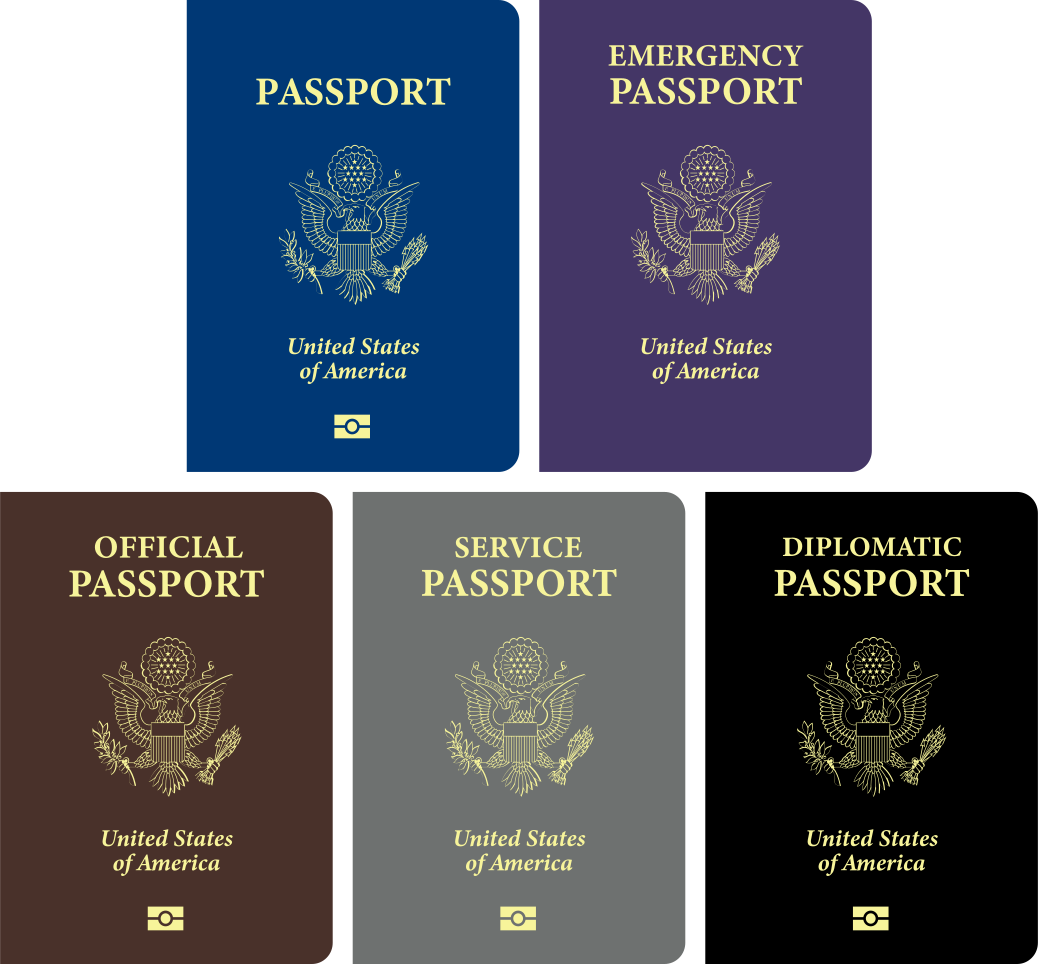
- U.S. passport or passport card
- Certain military IDs that include a photograph and signature
- Other current federal or state government IDs that contain a photo and signature
Under current guidance, expired IDs are not acceptable for Texas notarizations; the identification must be current. If a signer lacks acceptable ID, Texas rules allow the use of a properly identified credible witness who personally knows the signer, subject to Texas notary requirements.
For remote online notarization (RON), identity is confirmed through a combination of credential analysis of a government‑issued ID and knowledge‑based authentication (KBA) using secure audio‑video technology as required under Texas Government Code Chapter 406, Subchapter C.
Document Requirements
- Bring complete, unsigned document
- Document filled out except signatures
- All pages present
- Know type of notarization needed
- Multiple signers must appear together
Preparation Tips
- Review document beforehand
- Don’t sign until instructed
- Explain document’s purpose
- Bring extra copies if needed

When Do You Need a Notary?
Not every document requires notarization. Here’s when it’s typically necessary:
Legally Required
Real estate deeds, mortgage documents, powers of attorney, affidavits, court documents, and other legal instruments typically mandate notarization by law or institutional requirements.
Best Practice
Documents that may not be legally required but are strongly advised to be notarized for added protection, such as settlement agreements, custody agreements, or personal guarantees.
Not Always Required
Some documents like certain contracts or letters may function without notarization but benefit from it in specific circumstances. Notarization is optional depending on the situation.
The Notarization Process: Step by Step
Schedule Appointment
Contact DNS Notary to schedule mobile service at your location or book remote online notarization (RON) for convenience.
Verify Identity
Provide valid government-issued identification. The notary will verify your identity before proceeding.
Review Documents
Review the document(s) to be notarized. Do not sign until instructed by the notary.
Sign & Notarize
Sign the document in the presence of the notary, who will then apply their official seal and signature.
Receive Notarized Copy
Receive your notarized document with the official seal, signature, and date.
Mobile Notary vs Remote Online Notary (RON)
Mobile Notary Services
Traditional notarization where the notary travels to your location.
Best for:
- Documents requiring original signatures
- Signers unfamiliar with technology
- Multiple signers in same location
- Specialized situations (hospital, jail)
- When physical presence provides comfort
Advantages:
- Personal, face-to-face service
- No technology requirements
- Can handle large document packages
- Suitable for all ages
- Can handle large groups of signers
Remote Online Notarization (RON)
Notarization via secure audio-visual technology from anywhere.
Best for:
- Urgent, time-sensitive documents
- Signers outside San Antonio or out of state
- Evening/weekend convenience
- Electronic document signing
- Reducing exposure during health concerns
Advantages:
- Available 24/7 in many cases
- No travel time or fees
- Secure, recorded sessions
- Faster turnaround
- Geographic flexibility
Which Should You Choose? Consider your document type, location, urgency, and technology comfort level. Our team can help you determine the best option.
Special Notary Services
Loan Signing Agent Services
Certified loan signing agents specialize in real estate closings and mortgage document signings. This requires additional training beyond basic notary certification and knowledge of:
- Closing Disclosure (CD) review
- Note and deed of trust execution
- Right of rescission periods
- Title company procedures
- Signing appointment management
Specialized Mobile Services
DNS Notary provides mobile services in unique situations:
- Hospital notarizations – bedside service for medical documents
- Jail/correctional facilities – inmate document signing
- Nursing homes – services for elderly and disabled clients
- Corporate events – on-site notary for employee documents
- Emergency/urgent – same-day and after-hours availability
Texas Notary Law and Regulations
Texas notaries are governed by several key statutes:
Texas Government Code Chapter 406
Primary notary law covering appointment, duties, fees, and prohibited acts.
Texas Civil Practice & Remedies Code Chapter 121
Addresses notarial certificate requirements and acknowledgment forms.
Key Requirements
- 4-year commission term
- $10,000 surety bond
- Notary seal with specific information
- Journal of notarial acts
- Continuing education recommended
Prohibited Acts
- Notarizing with beneficial interest
- Notarizing for family (some cases)
- Providing legal advice
- Advertising as "notario publico"
- Charging fees exceeding maximums
Notary Liability
- Liable for negligence
- Improper ID verification
- False certificates
- Unauthorized practice of law
Why Choose DNS Notary LLC?
Experienced & Certified
State-commissioned notaries and certified loan signing agents with extensive training
Available 24/7
Emergency and after-hours services for urgent notarization needs
Veteran-Owned
Woman and veteran-owned business with military precision and commitment
Mobile Convenience
We come to you throughout the San Antonio area
Professional • Reliable • Competitive Pricing
Frequently Asked Questions
Can a notary notarize a document for a family member?
Texas law does not expressly forbid a notary from notarizing for a family member, but the notary may not perform a notarization if they are a party to the transaction or have a direct financial or beneficial interest in the document. To protect impartiality and avoid conflicts of interest, leading Texas notary authorities strongly recommend avoiding notarizations for close family members such as a spouse, parents, children, or in‑laws whenever possible.
Do I need an appointment?
For mobile notary services, appointments are required to ensure availability and proper scheduling. RON sessions can sometimes be completed immediately depending on availability.
How long does a notarization take?
Simple notarizations take 5-10 minutes per document. Loan signing appointments typically require 30-60 minutes. Time varies based on document complexity and number of signers.
Can a notary refuse to notarize?
Yes. Notaries must refuse if the signer cannot be properly identified, appears confused or coerced, or if the document is incomplete or appears fraudulent.
What if my ID is expired?
For in‑person notarizations in Texas, every signer must present current, unexpired government‑issued photo identification that includes a photograph and a signature, issued by a U.S. state or the federal government (for example, a Texas driver license or ID card, a U.S. passport, or similar government ID). Expired identification documents are no longer acceptable for Texas notarizations, even if they expired recently.
For certain real estate transactions, a current foreign passport may be acceptable if it meets Texas requirements, but it still must be unexpired. When a signer does not have acceptable ID, Texas allows use of a credible witness under specific conditions, and the notary must follow state procedures carefully to document that method of identification.
Can documents be notarized in languages other than English?
Yes, but the notary must be able to communicate directly with the signer to verify understanding and willingness. The notarial certificate is typically in English.
What is an Apostille?
An Apostille is a certification that authenticates the signature of a notary public for international use under the Hague Convention. Documents notarized in Texas can receive an Apostille from the Texas Secretary of State.
How long are notarized documents valid?
Notarizations don’t expire, but the accepting entity (bank, government agency, court) may have time limits for accepting notarized documents.
Schedule Your Notary Service Today
Whether you need mobile notary service at your location, remote online notarization from home, or a certified loan signing agent for your real estate closing, DNS Notary LLC is ready to serve you throughout San Antonio and surrounding areas.
Book Online
Schedule mobile or RON services through our convenient online booking system
Call Us
(210) 816-4038 - Speak with our team for immediate assistance
[email protected] - Send your questions and service requests
Service Area: San Antonio, Helotes, Leon Valley, Boerne, New Braunfels, Schertz, Cibolo, Universal City, and surrounding Bexar County communities.